Meme coin trading with a KOL audience or solo from a small bankroll and which is better for a beginner
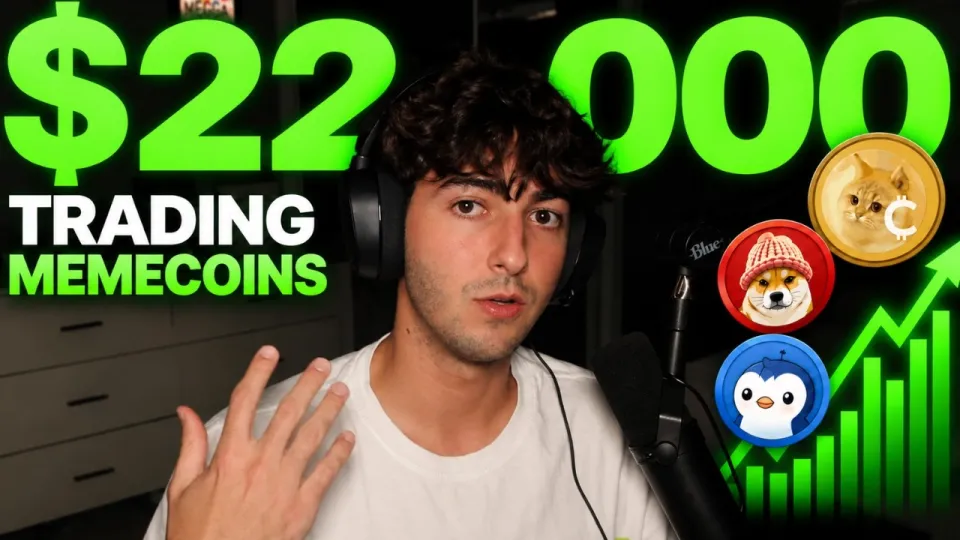
Video: How I Made $22,000 in a SINGLE Memecoin Trade (FULL GUIDE)
You can order the same kind of articles for your own video to boost it on YouTube and Google. Just message the Telegram bot @sat_sit_bot. It writes articles around your video, embeds the video and publishes them on popular niche websites (no ads). Try it free: 50 articles on us.
· based on the channel Megga
Key takeaways
- Megga's guide breaks down a single meme coin trade that produced $22,000 in profit.
- The video points beginners to a free guide at whop.com/wiredd and a trading terminal at trade.padre.gg/rk/megga.
- A KOL with a large audience can move a low-cap meme coin far faster than a solo trader with a small bankroll.
- Viewers pushed back that results would differ without an audience and friends trading alongside.
- Small-bankroll challenges ($25–$100 to $1,000) are the most requested follow-up format.
Meme coin trading rewards speed and information more than analysis, so the honest answer is that trading with a KOL audience beats trading solo from a small bankroll on execution and liquidity, while a solo account wins on risk control and repeatability. Megga's breakdown of a single meme coin trade worth $22,000 shows both sides of that split, and the free beginner material behind it is available through the Wiredd beginner guide on Whop.
What the $22,000 meme coin trade actually represents
A five-figure result on one meme coin position is a position-sizing story as much as a timing story. Megga's guide walks through a single trade end to end, and the number only makes sense if the entry size was large relative to the move captured. On a token that runs 3x, a $7,000–$11,000 entry produces roughly $22,000 of profit; on a 10x runner the same profit needs a far smaller entry. That arithmetic matters more than the headline, because it tells you the trade was built around a bankroll most viewers do not have.
Meme coins differ from major crypto assets in three practical ways: liquidity is thin, price discovery happens in minutes, and the only real edge is being early. A trader with an audience gets early for free, because their own posts and community create the flow. A solo trader has to find the token before that flow arrives, which is a different and harder job.
Why a KOL audience changes the meme coin equation
The structural advantage of trading with a large following is that attention is the asset. When an account with tens of thousands of engaged followers flags a low-cap token, buy pressure arrives within seconds, slippage moves in the trader's favor, and the exit has buyers waiting. Megga's channel, built around competitive gaming and now trading content, sits exactly in that position.
The second advantage is the network. Traders who share calls privately, compare wallets and coordinate entries effectively act as a small syndicate: they raise the floor under each other's positions and warn each other before a dump. That is not the same as a rug pull, but it is a real asymmetry, and viewers of the video raised the point directly — that trading without the audience and the group would likely produce a very different result.
How a solo trader can approach a meme coin with a small bankroll
A small account cannot copy a KOL's size, but it can copy the process. The steps below are the ones that survive without an audience:
- Fix the risk per trade before entry. With $100, risking 20–30% on a single meme coin position is already aggressive; never risk the whole balance on one token.
- Screen for liquidity and holder concentration first. A token with a thin pool or a single wallet holding a large share of supply is a rug risk regardless of the chart.
- Enter on the first pullback after launch rather than the vertical candle. Chasing the top of a green candle is how small accounts die.
- Take partial profit on the way up — selling half at 2x removes the possibility of turning a winner into a loss.
- Accept that most meme coin trades lose. A realistic small-bankroll goal is one or two good runners per week, not a $22,000 hit.
The math is unforgiving: a $100 account needs a 220x to reach the number in the video title. That is why the more useful comparison is percentage return, not dollar profit.
Typical questions and doubts from viewers of the meme coin guide
The most common pushback on results like this is that the outcome depends on the KOL bubble and on friends trading the same token. That criticism is fair as a caveat and does not invalidate the method — it simply means the method includes an audience you may not have. Treat the video as a demonstration of execution mechanics: how a position is sized, when profit is taken, how an exit is staged.
The second recurring request is for small-bankroll challenges, turning $25–$100 into $1,000. That format is more useful to beginners precisely because it forces discipline: with $50 on the line, position sizing stops being theoretical. The third is education on newer token types — tweet coins, profile coins and community coins — which behave differently from launchpad meme coins and need their own entry and exit rules.
Tools and links from the meme coin trade breakdown
Everything referenced in the video, in one place:
- Free beginner guide: https://whop.com/wiredd
- Trading terminal used for entries: https://trade.padre.gg/rk/megga
- Twitch: http://www.twitch.tv/megga
- TikTok: https://www.tiktok.com/@meggafaze
- Twitter: https://twitter.com/megga
- Instagram: https://www.instagram.com/fazemegga
A terminal matters on meme coins because execution speed and slippage settings decide whether a trade is profitable at all. The guide link is the better starting point if you have never sized a position or read a liquidity pool.
The verdict on meme coin trading with an audience versus alone
Trading with a KOL audience is better for hitting large dollar figures quickly, and trading solo from a small bankroll is better for learning risk control that survives more than one cycle. Megga's $22,000 single trade is a legitimate case study in sizing and timing, but it is not a template a $100 account can copy directly. Use the breakdown for mechanics, not for expectations, and start with the free beginner guide before putting capital at risk. Megga's channel is the source of the full walkthrough if you want to see the trade sequence in context.
Questions & answers
Can a beginner realistically turn a small bankroll into $22,000 with meme coins?
Not in a single trade. Reaching $22,000 from $100 requires a 220x return, which is far beyond normal meme coin outcomes. A realistic approach is to target percentage gains, take partial profits and accept that most positions lose money.
Does trading with a large audience give an unfair advantage on meme coins?
It gives a structural advantage in speed and liquidity, because attention creates buy pressure right after a call and provides buyers for the exit. That does not guarantee profit, but a solo trader without that flow is playing a harder version of the same game.
What should I check before buying a new meme coin?
Check pool liquidity, how concentrated the token supply is among top wallets, whether the contract has been renounced, and how long the token has existed. Thin liquidity and one dominant holder are the two clearest rug signals.
Why do traders take partial profits instead of holding for a bigger multiple?
Selling part of a position at 2x or 3x removes the risk of turning a winner into a loss, which is the most common mistake on meme coins. Holding the remainder keeps upside exposure while the realized profit protects the account.
Source: How I Made $22,000 in a SINGLE Memecoin Trade (FULL GUIDE) · Markdown version